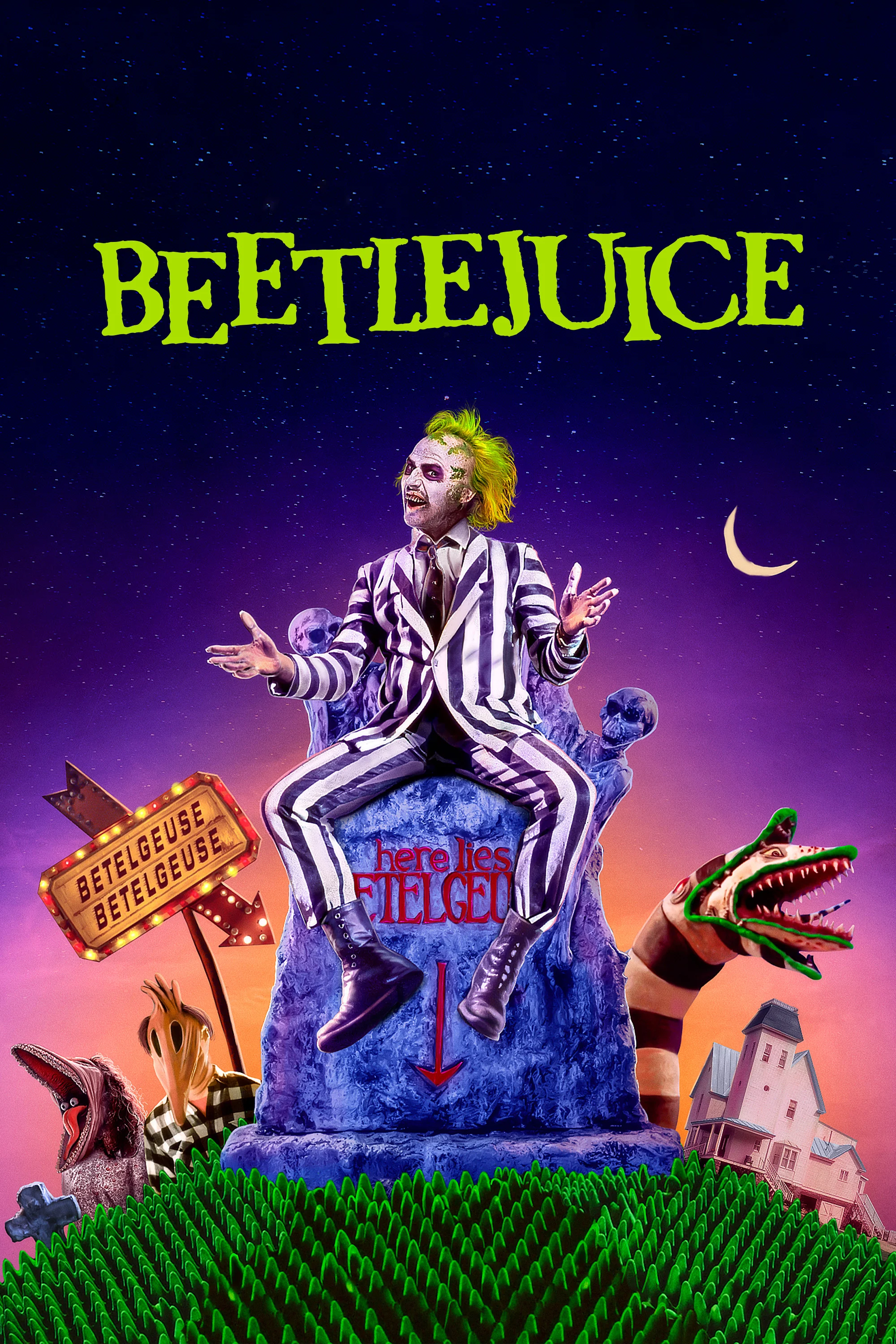

There are certain films that take us straight back to our earliest memories of watching movies, and Beetlejuice is firmly among them. Alongside High Spirits (1988) and the Peter Cushing adventure Dr. Who and the Daleks (1965), Tim Burton’s wonderfully peculiar supernatural comedy helped shape our early fascination with cinema. Naturally, there’s a fair amount of nostalgia attached to those memories, but nostalgia can only carry a film so far. Almost four decades later, *Beetlejuice* remains one of our all-time favourites, and revisiting it continues to remind us just how much Burton and his creative team got right.
The film announces its personality before anybody has even died. Danny Elfman’s unmistakable opening music accompanies a sweeping camera movement over a seemingly ordinary American town, gradually revealing that we’re actually looking at Adam Maitland’s miniature model. It’s a wonderful piece of practical filmmaking, bringing together the camera, the constructed environment and the story itself. There’s something particularly satisfying about that opening, especially knowing the town has physically been built rather than conjured up digitally. Elfman’s music is equally important to the experience. We only need to hear those first few bars to know exactly what’s coming, and having always paid particular attention to film scores and the individual signatures of composers, his work on *Beetlejuice* played an important part in developing that appreciation. His theatrical, occasionally frantic compositions fit Burton’s visual imagination perfectly.
The story is wonderfully straightforward. Adam and Barbara Maitland, played by Alec Baldwin and Geena Davis, are a happily married couple whose lives come to an abrupt end following a car accident. Unfortunately, being dead doesn’t release them from the responsibilities of home ownership. Their beloved house is soon occupied by the Deetz family, whose ideas about interior decoration are considerably less restrained than those of its previous occupants. The Maitlands understandably want them gone, but haunting people turns out to be rather more complicated than expected.
It’s a brilliant reversal of the traditional haunted-house scenario. Instead of following frightened homeowners trying to escape unwanted spirits, we’re rooting for the ghosts attempting to evict the living. Much of the narrative is fairly predictable once the premise is established, but that has never bothered us. Burton understands exactly what kind of film he’s making, and the story provides ample opportunity for the characters, humour and supernatural nonsense to do their thing.
Both Baldwin and Davis are excellent as the Maitlands. They bring a believable ordinariness to proceedings, which becomes increasingly funny as their circumstances spiral into absurdity. They’re decent people who would probably struggle to complain about a disappointing restaurant meal, let alone terrorise an entire family. Baldwin plays Adam beautifully, particularly when his attempts to understand their predicament meet yet another supernatural obstacle. However, Geena Davis has always made the stronger individual impression on me. There’s something about the warmth, humour and sheer naturalness she brings to Barbara. Davis really occupies that character. She owns Barbara Maitland. We can recognise Alec Baldwin the actor in Adam, whereas Barbara feels almost inseparable from Davis herself. That’s no criticism of Baldwin, because the relationship absolutely needs both performances to work.
The Deetz family provides an equally entertaining contrast. Catherine O’Hara is terrific as Delia, whose artistic ambitions and spectacularly questionable design choices are almost as alarming as anything the afterlife can produce. Winona Ryder’s Lydia, meanwhile, is the one member of the household capable of recognising the Maitlands for what they are. Her gloomy fascination with death makes her strangely better equipped to deal with the situation than the adults, who remain largely preoccupied with their own concerns.
Burton’s interpretation of the afterlife is quite possibly our favourite aspect of the entire film. Forget fluffy clouds, pearly gates or eternal damnation. Apparently, dying means entering another administrative system, complete with appointments, caseworkers, waiting rooms and an assortment of rules that nobody seems especially interested in explaining. It’s such a wonderfully ridiculous concept, taking something completely unknowable and turning it into the sort of frustrating bureaucracy we’re already familiar with while alive. You can almost imagine the Maitlands being told they’ve completed the wrong form and need to join another queue.
Sylvia Sidney’s Juno is especially memorable. Despite having relatively little screen time, her permanently unimpressed manner and matter-of-fact approach to the supernatural make her a wonderful supporting character. The waiting room is equally entertaining, populated by deceased individuals whose appearances explain precisely how they met their unfortunate ends. There’s the football team, the flattened dude complete with tyre marks, and various other unfortunate souls carrying the physical evidence of their deaths. It’s grotesque, funny and remarkably economical storytelling. These characters barely need to speak because their makeup, costumes and physical appearances tell us everything necessary.
We’ve always loved that attention to detail (i’ve probably spent hours actually watching the background of scenes because there is so much richness!). It creates the impression of an entire supernatural society operating beyond the Maitlands’ immediate problems. Frankly, we could happily spend considerably longer exploring those offices, corridors and waiting rooms. That’s not a complaint about the film’s pacing, which works perfectly well. It’s simply a world so entertaining that you naturally want to see what else is hiding around the next corner.
The practical effects are a huge part of what makes this peculiar world so enjoyable. Michael Keaton’s grotesque transformation when demonstrating his frightening abilities is a particularly memorable example. The exaggerated facial distortions are wonderfully unpleasant, but they’re also completely appropriate for a character whose entire existence seems dedicated to making everybody else uncomfortable. The same imagination is present in the deceased waiting-room occupants, where elaborate makeup and physical construction turn some fairly horrible circumstances into visual comedy.
Keaton deserves enormous credit for the character’s enduring appeal. Of course, Beetlejuice himself is the product of the writing, direction, makeup, costumes and effects teams working together, but it’s Keaton who injects the personality that has lasted for decades. Not to say that Beetlejuice On Stage isn’t just as iconic, because he is – no matter who is playing him. His physical comedy, unpredictable delivery and outrageous expressions turn what could have been a fairly conventional supernatural troublemaker into something extraordinary. It’s remarkable how thoroughly he dominates the identity of the film despite his comparatively limited screen time. He doesn’t need to be constantly present because every appearance leaves such an impression. Burton and Keaton would reunite for Batman the following year, but this earlier collaboration had already demonstrated how effectively their rather unusual creative instincts could work together.
Barbara’s excursions into the strange Saturn landscape, complete with enormous sandworms, are another memorable example of the film’s handmade approach. Watching those sequences today, it’s impossible not to recognise the influence of the sort of stop-motion work associated with Ray Harryhausen. The movement has that slightly mechanical quality familiar from older effects-heavy films, and yes, modern CGI could undoubtedly produce something smoother and technically more sophisticated. We can appreciate that the animation shows its age without considering it a weakness. There’s a tremendous amount of charm in those creations, and their slightly exaggerated movements feel perfectly suited to Burton’s peculiar environments.
I personally have always preferred practical effects where they’re appropriate, much as we as a whole at POTC tend to favour traditional film photography over digital capture. That doesn’t mean CGI has no place. It’s an extraordinary tool for creating impossible environments, extending sets and achieving things that would be impractical or downright impossible physically. However, there’s something wonderful about seeing an object, creature or miniature that somebody actually constructed, animated and photographed. The limitations can occasionally be visible, but they also contribute to a film’s personality. Technical sophistication doesn’t automatically make one approach artistically superior to another.
Interestingly, my teenage step-daughter watched this original Beetlejuice and absolutely loved it. She doesn’t have those childhood memories attached to the film, nor does she seem particularly bothered by the age of the effects. She simply watches what’s happening on screen and enjoys it. We can recognise the older animation techniques and appreciate the craftsmanship behind them, while she experiences the same sequences without viewing their age as an obstacle. It’s rather lovely to see something that meant so much to us growing up still entertaining somebody who approaches it from a completely different generation.
It’s also telling that Beetlejuice Beetlejuice, (which we will review!), released an astonishing 36 years after the original, deliberately returned to practical effects and stop-motion animation despite having modern digital technology readily available. Those techniques had become such an important part of the original film’s personality that revisiting them made artistic sense. We’ll give the sequel its own proper discussion, but that particular decision says plenty about the lasting appeal of the first film.
Burton’s ability to combine gothic imagery, grotesque characters and genuinely funny situations is something we’ve always admired. There’s a similar pleasure to be found in the 1990s Addams Family films with Raúl Juliá and Anjelica Huston, where death and the macabre become sources of wonderfully eccentric comedy. Beetlejuice belongs comfortably alongside them, although it has an identity entirely its own. The exaggerated environments, strange supporting characters, theatrical music and moments of deliberately ridiculous horror all work together without ever feeling particularly at odds with one another. Burton has always had an exceptional eye for this sort of material, and Beetlejuice remains one of his finest examples.
It’s difficult to think of many films from the period that remain quite so immediately recognisable (yes we know, bold statement!!). Mention Beetlejuice to somebody familiar with the character and there’s a good chance they’ll respond with another two Beetlejuices. His name, appearance and behaviour have become part of popular culture, and that doesn’t happen simply because a film has been around for a long time.
For me, Beetlejuice remains a solid film because the things we loved about it as children are still working today. The humour lands, the performances are terrific, the world is endlessly entertaining and the handmade effects possess a character that technological progress hasn’t made redundant. Having watched it countless times over the years, we still find ourselves enjoying those same peculiar details, particularly whenever the Maitlands venture into the administrative nightmare of the afterlife.
Apparently, even death doesn’t get you out of dealing with paperwork.