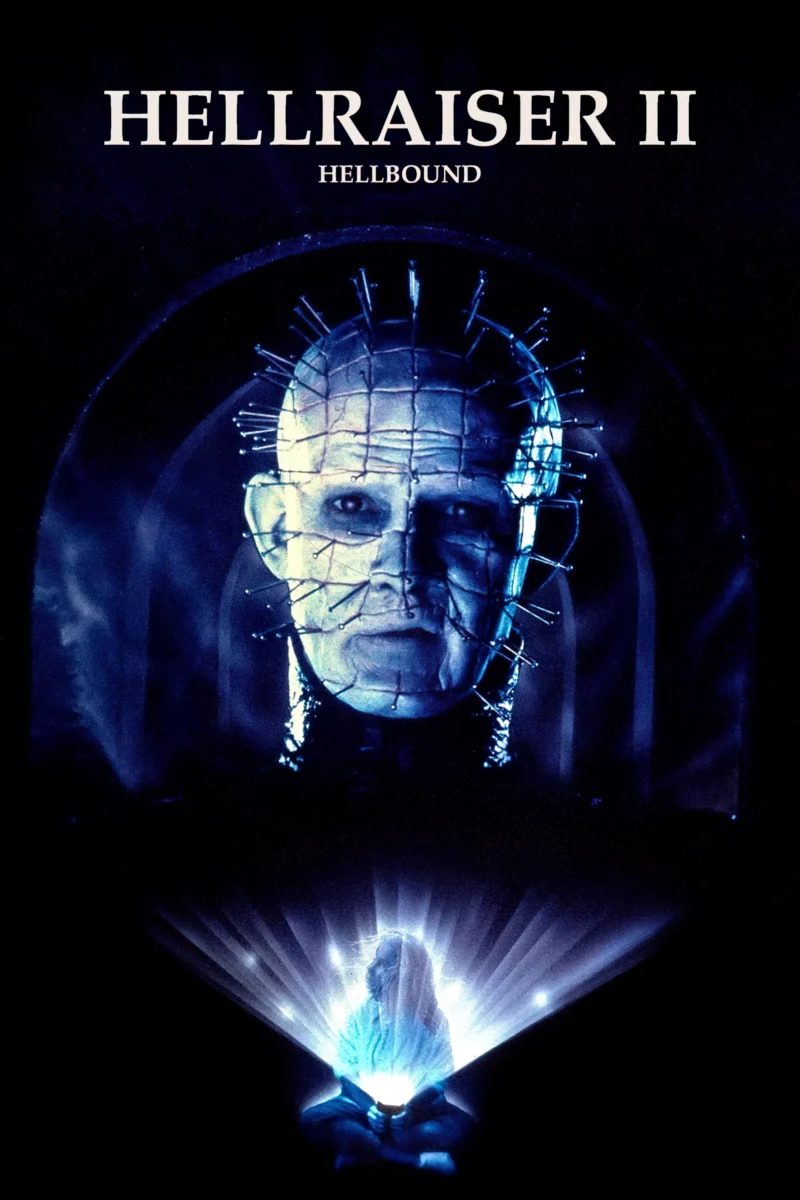


Some sequels arrive determined to establish themselves as the next big chapter, introducing new characters and generally pretending their predecessor has already done its job. Hellbound: Hellraiser II takes a rather more sensible approach. It picks up the pieces left behind by Clive Barker’s 1987 original, which, considering what happened to the Cotton family, is quite an undertaking.
We’ve always regarded these first two films as complementary halves of the same story. You can certainly watch Hellbound independently, and there’s enough here to understand what’s happening, but the experience is considerably better when you’ve already spent some time with Kirsty, Julia, Frank and their rather unhealthy relationship with a particular puzzle box. Watching both films together makes for an excellent double feature, although perhaps not one to accompany a large takeaway.
Tony Randel’s sequel follows Kirsty Cotton (Ashley Laurence), now confined to a psychiatric hospital following the events of the first film. Unfortunately, Dr Philip Channard (Kenneth Cranham), the man responsible for her care, has an interest in the Lament Configuration that extends considerably beyond professional curiosity. Before long, Julia (Clare Higgins) is back in the picture, and we’re heading towards another encounter with the Cenobites.
One of the things we appreciate about Hellbound is its commitment to continuing the existing story. The atmosphere, characters and general unpleasantness remain recognisable, with the consequences of the original film driving much of what happens here. There’s no need to manufacture a completely different threat when the first film established a world with so much unexplored territory.
Having said that, by the time Hellbound reaches its conclusion, we’re quite comfortable leaving the Cotton family behind. Kirsty has been an important character, and her involvement provides the audience with a way into Barker’s peculiar mythology. Ashley Laurence remains an effective presence throughout, but there comes a point when the people pursuing our protagonists become rather more interesting than the protagonists themselves.
For us, that’s always been part of the attraction of Hellraiser. The Cenobites, their origins and the strange order governing their existence offer considerably more possibilities than simply following another unfortunate person who happens to open the wrong box.
Bradley’s Pinhead remains one of the franchise’s greatest assets. His appearance is immediately recognisable, but there’s something about the character’s composure that makes him particularly effective. While everyone else is panicking, running around or being pulled apart, Pinhead conducts himself with the quiet authority of someone who knows exactly how this particular nightmare is going to end. Bradley never needs to make the character especially animated to establish his presence.
It’s difficult to imagine these early films without him, and Hellbound gives us another welcome opportunity to spend time with the original incarnation of the character. More interestingly, it begins exploring the Cenobites as part of a much larger supernatural hierarchy, rather than leaving them as mysterious visitors who occasionally appear to make somebody’s day considerably worse. That expansion of the mythology is probably our favourite aspect of the film.
The first Hellraiser offers glimpses of what exists beyond the Lament Configuration. Hellbound takes us through the doorway and introduces the labyrinth, an enormous, seemingly endless arrangement of corridors and chambers presided over by Leviathan. This strange geometric entity sits at the centre of a realm that feels governed by its own disturbing rules.
There’s something wonderfully unsettling about finally seeing where the Cenobites come from. It gives their existence greater context without requiring every aspect of their world to be explained. Leviathan itself raises plenty of questions, particularly concerning its relationship with the Cenobites and the amount of control it exercises over them. We’re given enough to appreciate that there’s an entire order operating beyond the human characters’ understanding. The labyrinth also happens to be one of the most interesting examples of the film’s distinctly 1980s production techniques.
Having watched Hellbound numerous times over the years, we’ve become increasingly conscious of how the filmmakers created the impression of such an enormous environment. Look closely at Kirsty’s journeys through the labyrinth and you’ll begin noticing familiar corridors, relatively narrow spaces and what appear to be painted backgrounds extending the scenery beyond the physical sets.
Some of those corridors seem to get quite a workout. Kirsty can run through what feels like half of eternity, despite the surroundings occasionally looking suspiciously familiar. There are moments when the supposedly endless labyrinth betrays its soundstage origins, and the illusion of enormous distances depends heavily on how the sequences are staged and edited.
We rather enjoy noticing these things.
Nearly four decades on, it’s easier to recognise the physical limitations of the production, particularly if you have an interest in how films are constructed. But there’s a certain pleasure in identifying the practical solutions filmmakers employed to suggest something far larger than they could actually build. The labyrinth might occasionally look like a collection of rearranged corridors, but it still establishes a distinctive environment that we’d happily explore further. Preferably without anyone attaching hooks to us. The same affection for practical filmmaking extends to Dr Channard, whose transformation into a Cenobite introduces another particularly interesting development.
Kenneth Cranham gives us a doctor whose fascination with the supernatural has already pushed him well beyond anything resembling medical ethics. His involvement in Julia’s resurrection is disturbing enough, but his eventual encounter with Leviathan takes the character somewhere considerably more unpleasant. The transformed Channard is a formidable creation, suspended and connected to the machinery of Leviathan’s realm. His abilities appear to exceed those of the Cenobites we’ve already encountered, particularly when he confronts Pinhead and his established companions.
Now, this is a sequence that has understandably raised a few eyebrows among Hellraiser enthusiasts. Having spent two films establishing Pinhead and his associates as extraordinarily powerful supernatural beings, Hellbound allows Channard to dispatch them with surprising efficiency.
We can understand why that might frustrate some viewers, but we’ve never particularly regarded it as a problem.
Our interpretation is that Channard’s connection to Leviathan gives him an advantage that the other Cenobites simply don’t possess. He’s effectively operating with power supplied by the entity responsible for the labyrinth itself. If that’s the case, his ability to overpower Pinhead’s group becomes much easier to accept.
It’s not an explicitly explained ranking system, and we’re certainly not suggesting the film provides a definitive answer about who outranks whom in Cenobite society. Nevertheless, the circumstances of Channard’s transformation offer a reasonable explanation for his extraordinary abilities. It also raises some interesting questions about what Leviathan might be capable of creating, given the opportunity. We can’t imagine the transformation itself being an especially pleasant experience either, although unpleasant experiences are hardly in short supply around here. There’s also a fascinating production detail concerning Channard that becomes more noticeable during repeated viewings. In certain wider shots, the transformed character appears to have slightly different facial features and physical proportions. It turns out there’s a genuine explanation for this. Cranham suffered a neck injury during production, and stunt performer Bronco McLoughlin subsequently portrayed the Channard Cenobite for much of the remaining filming. Cranham’s time performing in the elaborate Cenobite make-up was consequently very limited.
Once you’re aware of the substitution, it’s interesting to revisit those sequences and look for the differences. It’s another example of the practical complications involved in making this sort of film, particularly when actors are expected to perform while attached to elaborate effects equipment. The finished scenes are memorable enough without knowing the difficulties involved in producing them. Something else we’ve become increasingly aware of over successive viewings is the rather peculiar geography of the early Hellraiser films.
The original emerged from a distinctly British creative background, with recognisable British surroundings and much of its production rooted firmly in the UK. Yet both films have an occasionally confusing relationship with their supposed geographical setting.
There are British-looking houses, familiar surroundings and then, rather unexpectedly, American police officers wandering about as though they’ve taken a wrong turn somewhere over the Atlantic.
Hellbound continues this strange mixture. Given that the film was produced in England, there’s something amusing about watching American law enforcement turn up in environments that don’t always look particularly American. It’s almost as though the Cotton family’s house occupies some unexplained transatlantic territory where geography has become another casualty of the Lament Configuration.
Perhaps these decisions were influenced by the desire to appeal to American audiences. It would certainly make commercial sense, although that doesn’t explain every inconsistency. Whatever the reasoning, it’s one of those peculiar details we barely registered during earlier viewings but now find difficult to overlook. It doesn’t bother us in the slightest. If anything, it’s become another little curiosity to enjoy.
And that’s generally how we feel about the film’s other visible production limitations. Some of the effects betray their age, the enormous labyrinth isn’t always quite as enormous as it would like us to believe, and certain sequences reveal the practical realities behind the illusion. None of this prevents the film from being enjoyable. We can appreciate what the filmmakers were trying to achieve without requiring every technique to remain completely convincing nearly forty years later.
What Hellbound leaves us with is an expanded understanding of the world Clive Barker introduced in 1987. We know considerably more about the Cenobites, we’ve encountered Leviathan, and we’ve glimpsed the environment that exists beyond the puzzle box. Channard’s transformation also suggests that the supernatural order we’ve witnessed so far may contain far more dangerous possibilities.
Kirsty’s story, meanwhile, has reached a point where we’re perfectly happy to see her walk away. She’s certainly earned a break from the family business.
There are countless corridors left unexplored, and we’d much rather see what else might be lurking within them.