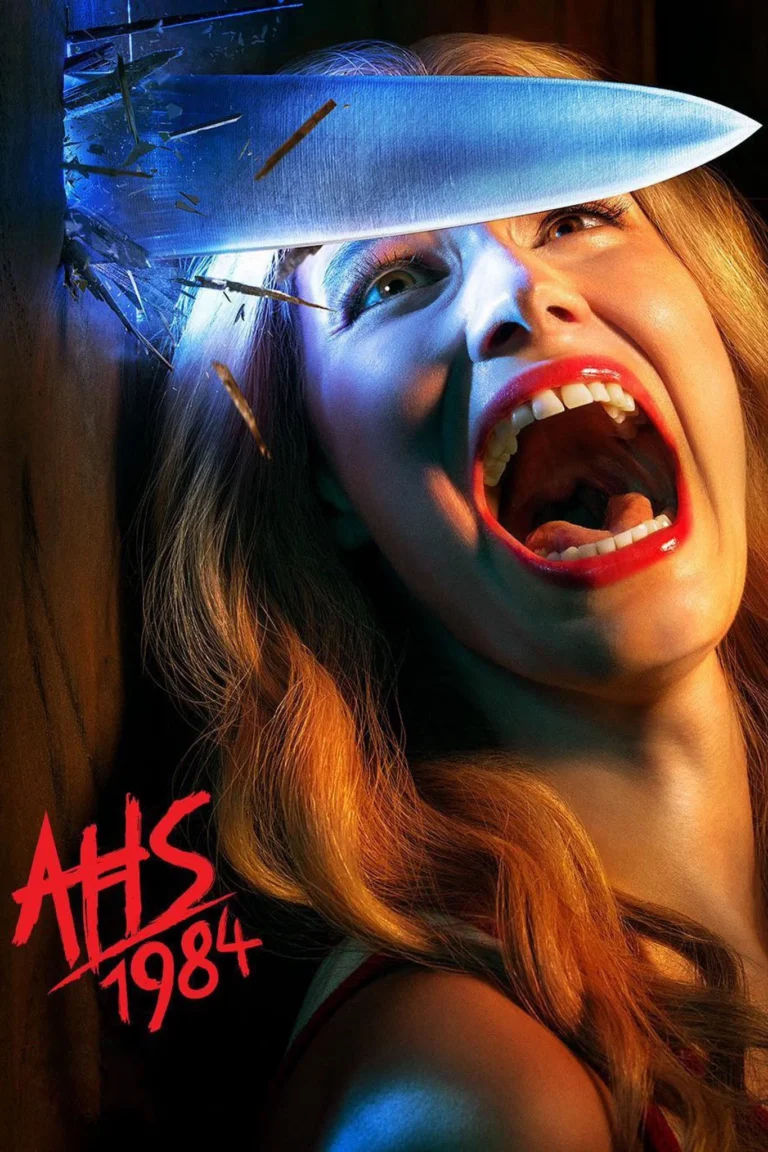

Of all the directions American Horror Story could have taken for its ninth season, a summer camp slasher set in 1984 seemed suspiciously close to something designed specifically for me. I’ve always been rather fond of 1980s horror, and the prospect of a series stuffed with isolated cabins, deranged killers, questionable teenage decisions and enormous knives was enough to get my attention. Throw in the music, the hairstyles and the glorious excess of the decade, and surely this was going to be a winner? – this does contain spoiler (you all know the deal!).
After all, this is the era that gave us A Nightmare on Elm Street, Hellraiser and the wave of slashers that followed the original Halloween. Films where surviving the night was a considerable achievement and common sense usually met a horrible death somewhere around the second act. *American Horror Story: 1984* understands these influences perfectly, and in terms of atmosphere and presentation, it gets an awful lot right. Unfortunately, having all the ingredients for a terrific horror story and knowing what to do with them are two very different things.
The premise is wonderfully straightforward. A group of young adults leave Los Angeles to work as counsellors at Camp Redwood, a remote summer camp with a particularly unpleasant history. Years earlier, a massacre left several people dead, their ears removed as trophies by a killer supposedly responsible for the slaughter. That killer, Benjamin Richter, better known as Mr. Jingles, has become something of a local legend. Naturally, the camp is reopening, because apparently nothing says sensible business investment quite like resurrecting the scene of a notorious mass murder.
Initially, this works rather well. John Carroll Lynch’s Mr. Jingles gives me exactly the sort of antagonist the setting deserves, and the unfolding mystery surrounding the original killings provides a solid foundation for the season. Better still, the revelation that Richter was framed for the massacre by Margaret Booth, played by Leslie Grossman, adds a welcome twist. Margaret’s development from a disturbed young woman into an equally disturbed older one is a particularly enjoyable element of the story. Suddenly, the supposed monster isn’t quite the monster I thought he was, and the respectable woman overseeing the camp has considerably more skeletons in her wardrobe than the guests might appreciate.
There was enough in that storyline alone to make ‘1984′ something special. A wrongly accused killer returning to the place that destroyed his life, the woman responsible maintaining her elaborate deception, and a fresh group of potential victims caught between them. I could have happily spent considerably more time exploring that particular mess.
Instead, the writers appear determined to squeeze every conceivable horror convention into nine episodes, whether it belongs there or not. The relatively straightforward slasher mystery soon finds itself competing with Satanic intervention, supernatural resurrection, vengeful ghosts, family tragedy, multiple timelines and enough additional serial killers to warrant their own police department. Several of these ideas are interesting individually, but they increasingly struggle to coexist within the same story.
Which brings me to Richard Ramirez.
Now, American Horror Story has never been shy about incorporating actual historical figures into its fictional horrors, and I have no fundamental objection to that approach. Ramirez, the real-life Night Stalker, was a deeply unpleasant individual whose documented crimes already provide more than enough material for a frightening story. He was eventually captured, convicted and imprisoned, dying in custody in 2013.’ 1984′, however, decides to take his existence in an altogether more supernatural direction.
Played by Zach Villa, Ramirez becomes increasingly entangled in Satanic resurrection and the bizarre happenings at Camp Redwood. The difficulty isn’t that American Horror Story has suddenly abandoned reality. This is, after all, a programme where witches, ghosts and demons regularly turn up and ruin everybody’s evening. The problem is that Ramirez was an actual person with a known history, and the more supernatural liberties the writers take, the harder I find it to reconcile their character with the man they’re supposedly portraying.
Had Ramirez been an entirely fictional serial killer, I might have accepted the whole business without much complaint. Give him another name, make him a deranged Satanist with an unusually reliable arrangement for returning from the dead, and off we go. By insisting that he’s Richard Ramirez, the writers introduce a complication that increasingly distracts from everything else happening at the camp.
What’s particularly peculiar is that the franchise had already handled this character rather effectively. In my previous review of American Horror Story: Hotel, I discussed the infamous Devil’s Night gathering hosted by James Patrick March at the Hotel Cortez. Ramirez appears alongside the likes of Aileen Wuornos, Jeffrey Dahmer, John Wayne Gacy and the Zodiac Killer, all attending a thoroughly unpleasant dinner party that makes your average family Christmas look positively civilised.
That appearance worked because it was relatively contained. These historical murderers existed within an established supernatural setting, and their presence made sense within the peculiar rules of the Cortez. Ramirez didn’t require an elaborate alternative life story or an ongoing arrangement with Satan. He simply appeared, did his thing and left me to contemplate the world’s worst guest list. Hotel gave the character enough room to work without allowing him to consume the entire narrative.
I’ve seen the franchise use actual history to its advantage elsewhere, too. American Horror Story: Cult incorporated Valerie Solanas, her SCUM Manifesto and the attempted assassination of Andy Warhol into its fictional storytelling. Considerable liberties were taken, certainly, but the historical material had a purpose within the narrative. With ‘1984′, the Ramirez storyline increasingly feels as though the writers were more interested in the possibilities of using the Night Stalker than whether those possibilities made sense together.
Unfortunately, the supernatural complications don’t end there. Camp Redwood gradually reveals itself to be another location where the spirits of the dead remain trapped, unable to venture beyond its boundaries. It’s familiar territory for American Horror Story, and perhaps rather too familiar by this point.
Season 1 Murder House established the idea of spirits being bound to a particular property, while Hotel returned to similar territory through the Cortez. AHS: Roanoke also explored supernatural horrors connected to a specific location, albeit through its own mythology. These seasons don’t operate under identical rules, but the underlying device has become increasingly recognisable. So when ‘1984′ introduces yet another collection of ghosts condemned to remain where they died, it feels rather less imaginative than it probably should.
There is, admittedly, a potentially fascinating explanation lurking beneath the surface. The introduction of Lavinia Richter, played by Lily Rabe, takes the story back to the tragedy that devastated Benjamin Richter’s family. Lavinia’s younger son, Bobby, died after being struck by a boat propeller while swimming at the camp, an accident for which she blamed Benjamin. Her grief and subsequent murderous rage eventually become connected to the supernatural curse surrounding Camp Redwood.
It’s a grim little story, and one that deserved much more attention than it received. The suggestion that Lavinia’s suffering and hatred somehow poisoned the location gives the haunting a personal foundation, rather than simply declaring the camp cursed because somebody needed somewhere to keep all the ghosts. Yet the explanation arrives without enough development to make the mythology particularly satisfying. I’m given the broad idea, but much of the interesting detail is left for me to piece together.
The programme treats the lake as an ominous place, closely connected to the Richter family tragedy, and there are suggestions of something considerably stranger lurking beneath its waters. I couldn’t help wondering whether the writers were hinting at some sort of supernatural gateway, perhaps something resembling a hellmouth a’la Buffy. That would certainly have been an interesting direction, and it might have given Camp Redwood a mythology more distinctive than another haunted property with inconvenient boundary restrictions.
Instead, the lake becomes central to Benjamin’s eventual reunion with his deceased family. After being attacked by the other ghosts and placed in a boat, Benjamin is dragged beneath the water by the spirit of his younger brother (possibly?!). He subsequently finds himself reunited with Bobby and Lavinia, whose rage finally appears to have subsided. There’s a genuinely appealing idea here, particularly given everything Benjamin has suffered, but I’m left wanting to know considerably more about how this resolution works and what it means for the spirits involved.
Benjamin then effectively disappears from the other ghosts’ experience for decades, only to return when his adult son, also named Bobby, arrives at the camp. The story gives me enough to understand the intended emotional resolution, but I never felt that the supernatural mechanics surrounding it had been explored properly. Once again, an interesting development arrives, makes its contribution and moves aside before I’ve had much opportunity to get comfortable with it.
Meanwhile, Ramirez has somehow become the subject of a thirty-year supernatural security operation. The ghosts of Camp Redwood repeatedly murder him whenever Satan resurrects him, preventing the Night Stalker from escaping and threatening Benjamin’s surviving son. The immediate purpose is clear enough, and there’s something wonderfully absurd about a group of ghosts maintaining a permanent rota for murdering the same individual. But the wider implications of this arrangement raise questions the season never adequately resolves for me.
Am I supposed to accept that the real Richard Ramirez abandoned his documented historical fate entirely? How does this account sit alongside the version already introduced in Hotel? The writers can certainly invent whatever supernatural rules they please, but I still need enough confidence in those rules to follow the story without continually stopping to untangle them.
The increasingly crowded narrative isn’t helped by the noticeably different ensemble. One of the great pleasures of American Horror Story has always been its recurring performers, almost like a theatrical company whose members return each season to inhabit entirely different personalities. Familiar faces become part of the franchise’s character, even when the stories themselves have little obvious connection.
For ‘1984′, the absence of Sarah Paulson, Evan Peters and Angela Bassett leaves some noticeable gaps. That’s not to suggest the remaining cast is incapable of carrying the season. Emma Roberts, Billie Lourd, Leslie Grossman and John Carroll Lynch are all established members of the AHS family, while Matthew Morrison’s appearance as Trevor Kirchner brings another recognisable face into proceedings. Nevertheless, the ensemble doesn’t quite have the familiar weight I’ve come to associate with the programme.
Dylan McDermott’s arrival as Bruce initially seems like an opportunity to restore some of that familiar presence. Having appeared in Murder House, he’s certainly a welcome returning face, but I’m left questioning what his character really contributes. Bruce is another dangerous serial killer whose storyline includes some particularly unpleasant encounters, not least the (spoiler folks!) removal of his thumbs. He eventually meets his end outside the camp’s boundaries, preventing him from joining the resident ghost population. It’s all suitably horrible, but was another killer really necessary when the existing story was already struggling to accommodate the ones it had?
By the time I arrive at the finale, ‘1984′ has accumulated an extraordinary amount of narrative baggage. There’s the original massacre, Margaret’s murderous history, Benjamin’s tragic family, the camp’s supernatural conditions, Ramirez’s repeated resurrection and a collection of ghosts who have spent decades occupying the same patch of woodland. The strange thing is that, despite everything happening, the season still manages to feel unfinished.
The final episode introduces Benjamin’s adult son Bobby, played by Finn Wittrock, who returns to Camp Redwood in search of answers about his father. Through his encounters with the surviving characters and the trapped spirits, more is revealed about the events of the intervening years. The ghosts have been protecting him from Ramirez, and the concluding encounters allow Bobby to understand something of his family’s history before leaving the camp behind.
I can appreciate what the writers were attempting. There’s a bittersweet quality to Bobby’s eventual departure, with the spirits gathering near the camp boundary to watch him leave. Benjamin and his family have found a measure of peace, and Bobby has the opportunity to live a life free from the horrors that consumed theirs. It’s an appropriate emotional destination for this particular story.
But the moment Bobby turns around, acknowledges the gathered spirits and walks away, I couldn’t escape the feeling that something was missing. The credits arrive, the season is over, and I’m apparently expected to be satisfied that everything has reached its natural conclusion.
It genuinely felt as though I’d reached the middle of a much longer story. Not necessarily because I needed another nine episodes of people being stabbed in cabins, although the decade certainly had plenty of practice at that, but because so many of the season’s more interesting ideas deserved further exploration. Some developments are resolved with surprising speed, others are simply absorbed into the supernatural mythology, and a few seem to have wandered into the woods without anybody noticing they never returned.
Of course, American Horror Story has revisited earlier narratives before. Apocalypse brought together elements of Murder House and Coven, demonstrating that seemingly separate seasons can become part of something larger. Further exploration of Camp Redwood’s mythology could provide additional context for some of the ideas introduced here, but ‘1984′ still needs to stand on its own nine episodes.
And that’s where my disappointment really lies. I didn’t hate American Horror Story: 1984. Far from it. I enjoyed the aesthetic, the music, the slasher influences and a good deal of the initial mystery. Mr. Jingles and Margaret Booth provided some genuinely entertaining developments, while the Richter family tragedy suggested a much more interesting supernatural story than the one I eventually received.
Yet for all those individually appealing elements, ‘1984′ never quite manages to bring everything together. It is probably the weakest season of American Horror Story I’ve encountered so far, which is especially disappointing given how perfectly its premise seemed suited to my tastes. I went in expecting a potential favourite and came away feeling distinctly underwhelmed.
I could write all day about this season, but in the spirit of AHS: 1984, I’ll stop before I’ve properly finished. A wonderful concept, unfortunately let down by its execution.